Enterprise Model Canvas
A free one-page tool for designing how an organisation learns its way from the business model it has to the business model it needs.
The Business Model Canvas gave teams a shared language for how a business creates and captures value. The Value Proposition Canvas gave them one for why a customer would care.
Both make a model visible. Neither describes the conversation that comes after the model is on the wall:
What did we learn — and how should that learning change the business model?
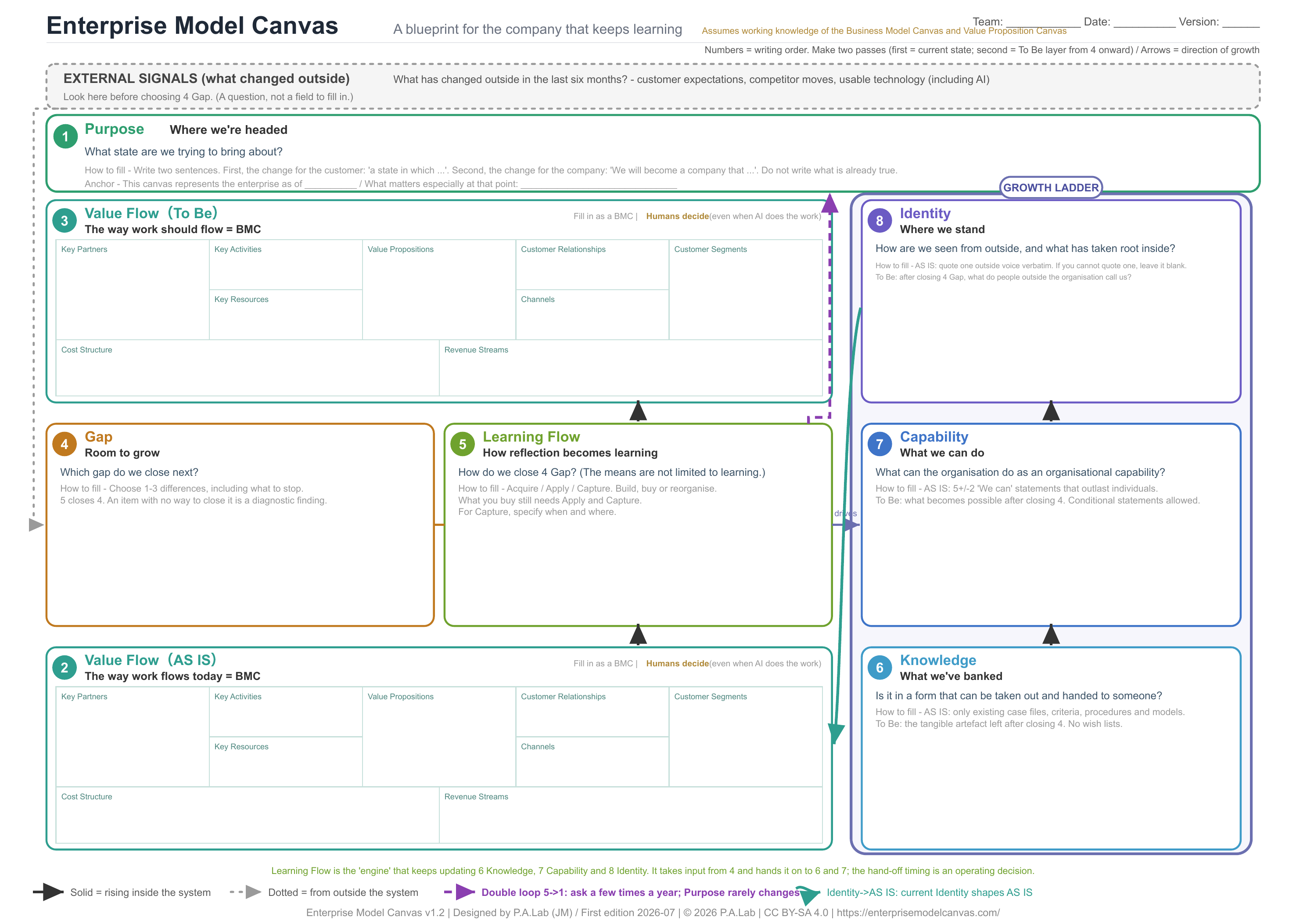
Enterprise Model Canvas puts that chain on one sheet.
The idea in one sentence
Guided by Purpose, move the current AS IS business model toward the intended To Be business model. Close the difference through organisational learning.
EMC does not replace the Business Model Canvas. It uses it twice — once for the model actually operating today, once for the model the organisation intends to create. BMC already carries vocabulary that works with both executives and the front line, so EMC adds no new notation for those blocks.
Which also means EMC assumes you already have BMC and VPC fundamentals. It is not an entry-level sheet.
Eight blocks
The numbers are the order you fill it in. Work through them and you complete one lap.
| Block | The question | |
|---|---|---|
| 1 | Purpose | What state are we trying to bring about, and for whom? |
| 2 | Value Flow (AS IS) | How does the business actually work today? (a BMC) |
| 3 | Value Flow (To Be) | How should it work? (a second BMC, same scope) |
| 4 | Gap | Which one to three differences will we close next? |
| 5 | Learning Flow | How will experience become learning that closes that gap? |
| 6 | Knowledge | What have we banked in a reusable form? |
| 7 | Capability | What can we do that survives any one person leaving? |
| 8 | Identity | How are we actually seen, and what has taken root? |
The arrows printed on the sheet are something else: the direction things grow. Experience becomes reusable Knowledge; repeated use turns it into organisational Capability; and capability, once recognised, changes Identity. We call those three rungs the Growth Ladder.
Writing order is sorted by what is easiest to start with. Growth order is sorted by cause. There is no reason the two should match.
Why Identity comes last
Asking “who are we?” first almost always produces an untested self-description — we are trusted, we are innovative, we put customers first. EMC delays it until two honest business models are on the table. If the AS IS revenue box says “contracted repair work,” then “the market sees us as the company that fixes breakdowns” is no longer a branding opinion.
This matters because capability alone does not rewrite a business model. Standing does.
Where AI sits
Two business models written in the same notation are unusually easy for an AI to compare. Hand it the finished sheet and ask where Purpose and To Be disagree, whether the chosen Gap is real, and which blocks changed quietly. Human teams are drawn to the dramatic change; an AI reads all nine blocks evenly.
AI points. Humans decide. Even when AI does the work, humans decide.
What changed in v1.2
v1.2 is a writing-method release. No box was added, no line was added. The sheet looks the same.
The change is that Knowledge, Capability and Identity are now written in two layers — AS IS and To Be — just as Value Flow is already two sheets. You fill the canvas in two laps: the first lap records where you actually are, the second lap records the plan.
- Two laps. Lap 1 = current state (AS IS layers only, ~60 min). Lap 2 = plan (To Be layers, ~30–40 min), in the same numeric order.
- Differences go in Gap, and nowhere else. Every To Be line has to answer “which Gap row does this close?” If it cannot, it is not written.
- An anchor line. The sheet now states which point in time it describes — separate from the date it was drawn. Move the anchor and everything on the sheet moves with it.
- Purpose in two sentences. One for the change in the customer, one for the change in the company.
- Capability is organisational. “We can do X” or “we cannot do X” — never “we can, if a particular person is on it.” Dependence on individuals is a Gap, not a capability.
- Learning Flow in three stages — Acquire, Apply, Capture — and Capture has to say when and where.
v1.2 is a release put out before outside critique, not after. If a block does not survive contact with your organisation, that is what the next version is for.
Download
English — v1.2
- Canvas (A3, PDF) — the sheet itself
- Quick Start (A4, PDF) — first lap 60 min, second lap 30–40 min
- Worked examples (A3, PDF) — company scale and department scale
The Japanese edition is the original; the English edition is its v1.2 translation. Both editions now use the same eight blocks, two-layer structure and two-lap writing method.
Previous version: v1.1 Canvas · v1.1 Quick Start · v1.1 worked examples
Released under CC BY-SA 4.0. Use it, teach it, translate it, run workshops with it. Keep the attribution and share derivatives under the same licence.
日本語 — v1.2(原典・最新)
v1.2の変更は「書き方」だけです。欄も線も増えていません。⑥⑦⑧を AS IS/To Be の2層で書き、2周して埋めます。変更点(英語)
旧版=v1.1 キャンバス/v1.1 QuickStart/v1.1 記入例
Read more
- Your Business Model Canvas Has No Memory — why this exists
- Inside the Enterprise Model Canvas — a block-by-block walkthrough
Where this is now
The structure and the teaching set are fixed. Field validation is the next stage. The questions that matter now are practical: can an experienced BMC user understand the structure without explanation, can a team complete a useful first pass in 60 minutes, does the chosen Gap lead to a specific Learning Flow, and what breaks when the canvas meets a real organisation.
If you try it, please say where your team got stuck. A confusing block is not a user failure — it is evidence for the next version.
日本語で読む
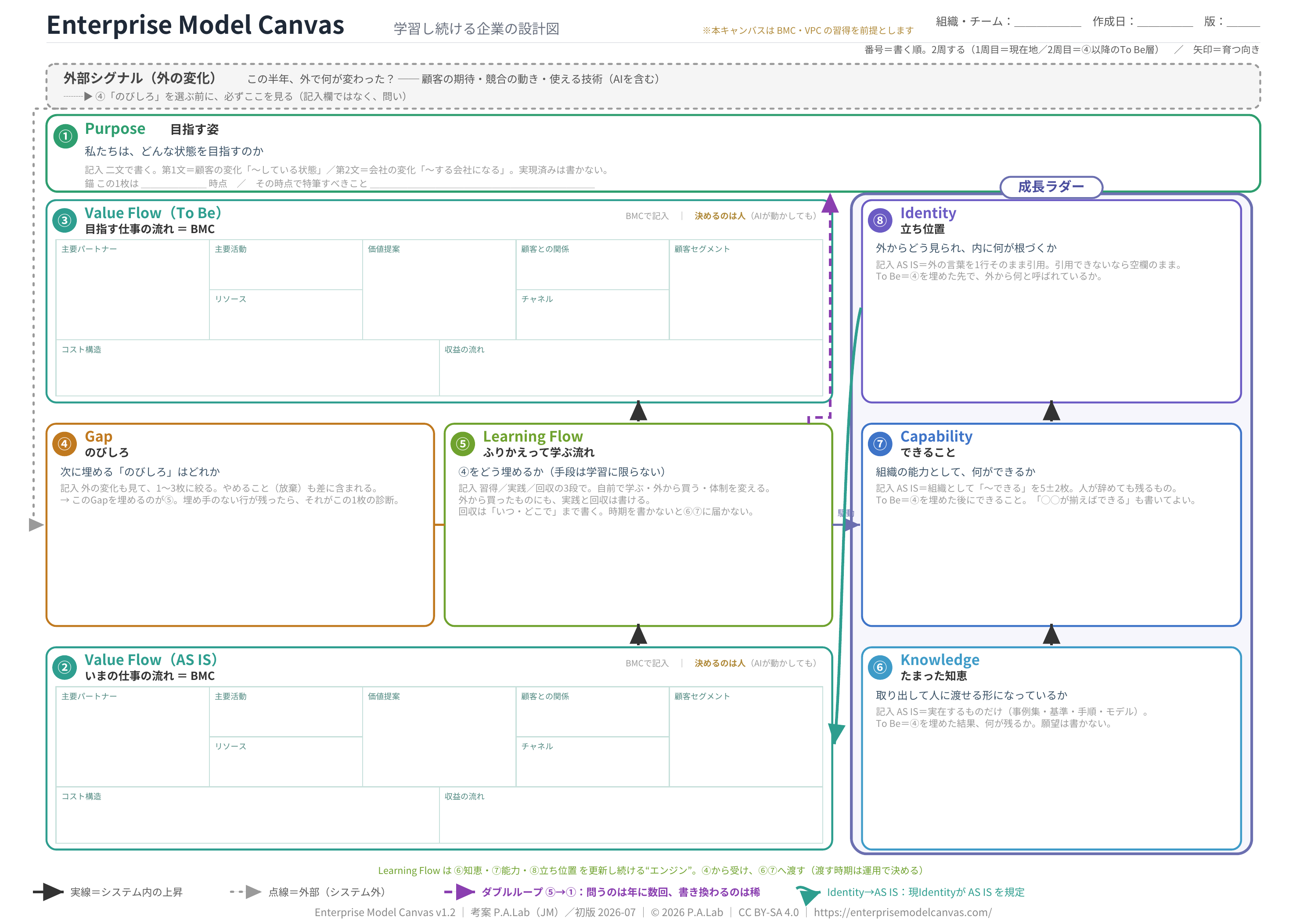
Enterprise Model Canvas(EMC)は、BMC・VPCの系譜に連なる「第3のキャンバス」です。いまの事業モデルと目指す事業モデルを2枚のBMCで並べ、その差を組織の学びで埋める設計を一枚で行います。
CC BY-SA 4.0で無料公開しています。出所を表示し同じ条件で継承する限り、社内研修でもクライアントワークでも自由にお使いいただけます。
最新は v1.2(2026年9月)です。目玉は⑥Knowledge・⑦Capability・⑧Identity を AS IS/To Be の2層で書くこと。左(②③)が2枚あるのと同じ構造で、右も2層になります。欄も線も増やしていません。→ ダウンロード
v1.2は、第三者に叩かれる前に出した版です。詰まった欄があれば、それは次の版のための材料です。ぜひ教えてください。